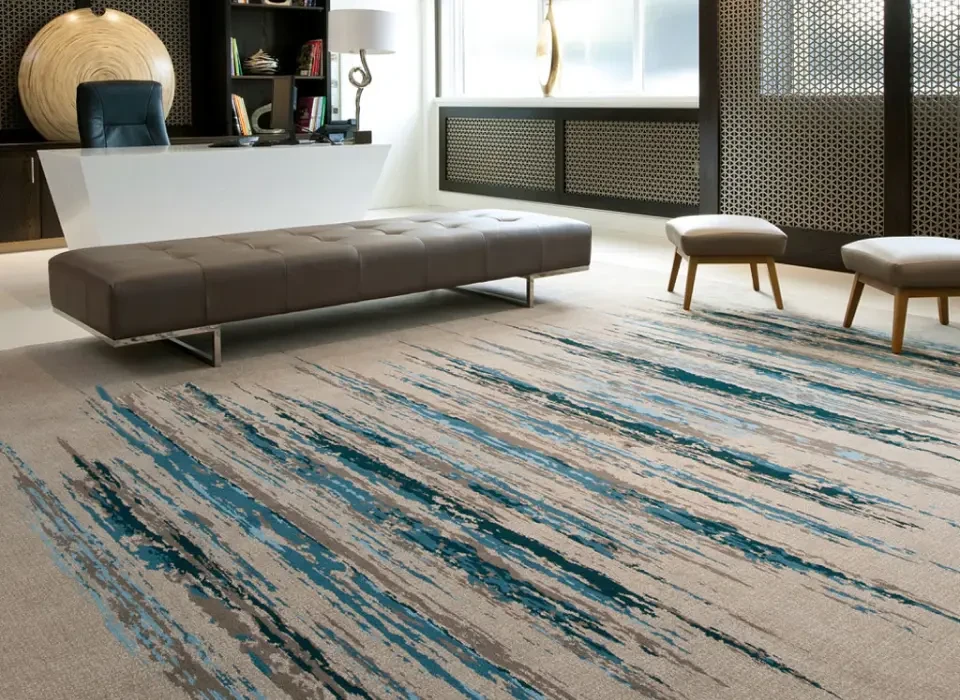
How Custom Carpet Manufacturing Minimizes Installation Seam Waste
Seams don't get much attention in early project meetings, but by the time installation starts, they can quietly become one of the biggest drivers of wasted material and added labor on a commercial flooring job. A layout that doesn't account for a space's actual dimensions forces installers to cut around problems on the fly, generating scrap, extra seams, and slower installation timelines. Custom carpet manufacturing addresses this at the source, by building a project's roll dimensions and layout into the production process itself rather than leaving it to be solved on site.
This guide looks at where seam waste typically comes from, how custom manufacturing reduces it, and why involving a manufacturer early in the planning process pays off across the life of a project.
What Causes Seam Waste in Commercial Carpet Installations?
Most seam waste traces back to a mismatch between standard product dimensions and a space's actual layout. Off-the-shelf carpet typically comes in fixed roll widths, which weren't designed with any particular floor plan in mind. When a room's dimensions don't divide evenly into that standard width, installers are left cutting and piecing material to fit, often creating more seams — and more waste — than the space actually requires.
Complex floor plans compound the problem. Irregular room shapes, columns, and transitions between spaces all add cutting complexity that a generic roll size wasn't built to accommodate. Pattern matching adds another layer of difficulty, since aligning a repeating pattern across multiple carpet widths can require additional material simply to get the pattern to line up correctly at each seam. Inaccurate material estimation at the takeoff stage often makes all of this worse, either underestimating what a project actually needs or over-ordering material that ends up as scrap.
How Custom Carpet Manufacturing Reduces Material Waste
Project-Specific Roll Width Optimization
Rather than working within fixed, standard roll widths, roll width optimization allows manufacturing to be planned around a specific project's actual room dimensions. When roll widths are calculated to match a space rather than the other way around, installers need fewer cuts and fewer seams to cover the same square footage, directly reducing the amount of material lost to trimming and piecing.
Smarter Layout Planning
Custom manufacturing works best when it's paired with detailed carpet layout planning done before production begins. Mapping seam locations against a floor plan in advance — accounting for doorways, furniture zones, and high-visibility sightlines — lets manufacturers produce material sized to that specific plan, rather than leaving layout decisions to be worked out reactively during installation.
Pattern Alignment and Seam Positioning
For patterned or custom-designed carpet, seam positioning becomes even more important, since a mismatched pattern at a seam is immediately noticeable. Planning pattern repeat and seam placement during the manufacturing stage, rather than after material arrives on site, reduces the excess material often needed to compensate for alignment issues discovered mid-installation.
Precision Manufacturing for Installation Efficiency
Precision manufacturing ensures that what arrives on site matches the planned layout closely enough that installation teams can move efficiently, rather than improvising around dimensional surprises. This kind of accuracy shortens installation timelines and reduces the likelihood of last-minute material orders to cover unexpected shortfalls.
The Financial Benefits of Reducing Seam Waste
The impact of reduced seam waste extends well beyond the material itself. Less waste generally means lower overall material costs, since project teams aren't purchasing excess product to cover inefficient cutting. Installation crews also move faster when layouts are pre-planned and material is sized correctly, which reduces labor hours and shortens project timelines. Fewer unplanned seams mean fewer installation challenges to troubleshoot on site, and a finished floor with intentional, well-placed seams typically delivers a cleaner final appearance. Taken together, these factors contribute to stronger long-term project cost optimization, not just savings on the initial material order.
Planning for Successful Commercial Flooring Projects
The clearest way to capture these benefits is to involve a manufacturer early in the specification and planning process, rather than treating manufacturing as a step that begins only after design and layout are finalized. Sharing floor plans, traffic patterns, and design intent with a manufacturer during early planning allows roll width and layout decisions to be made with the actual project in mind. This kind of early collaboration tends to produce more accurate flooring estimation, fewer surprises during installation, and a final result that's both more efficient to install and better suited to the space.
Why Contempo Carpets Is a Trusted Partner for Custom Carpet Manufacturing
Contempo Carpets works with estimators, architects, and flooring contractors to plan custom manufacturing around a project's specific layout, helping reduce unnecessary seam waste while supporting the design intent behind each installation. That combination of bespoke carpet production and collaborative planning reflects a broader approach to custom flooring solutions, one shaped by direct experience across a range of commercial interiors. Readers can learn more about that background on the About Us page, or explore examples of completed designs to see how project-specific manufacturing comes together in practice.
Where the Real Savings Come From
Reducing seam waste isn't just a manufacturing detail — it's a planning decision that affects material costs, installation timelines, and the finished appearance of a commercial flooring project. Custom carpet manufacturing, built around a project's actual dimensions rather than standard roll sizes, gives project teams a more efficient path from specification to installation, with fewer surprises and less waste along the way.
Ready to see how project-specific manufacturing could reduce waste on your next flooring job? Get a project estimate and start the planning conversation early.

-webp.webp)